
Home › Guided systems › Work Sharp Precision Adjust review
Review · Guided systems
Work Sharp Precision Adjust Elite Review: Angles, Grits and Who It Suits
Research-based pick We haven’t used it ourselves yet. Here’s the research behind our verdict.
The Precision Adjust Elite is the guided sharpener we point most knife owners to: set any angle from 15° to 30°, clamp the knife, and every stroke lands in the same place. Here’s what it does well, where it falls short, and whether you need the Elite or the standard model.
Not sure of your knife’s angle? See the angle chart →
We earn a small commission when you buy through our links. It never changes what we recommend. How we test → · Last updated: November 2026
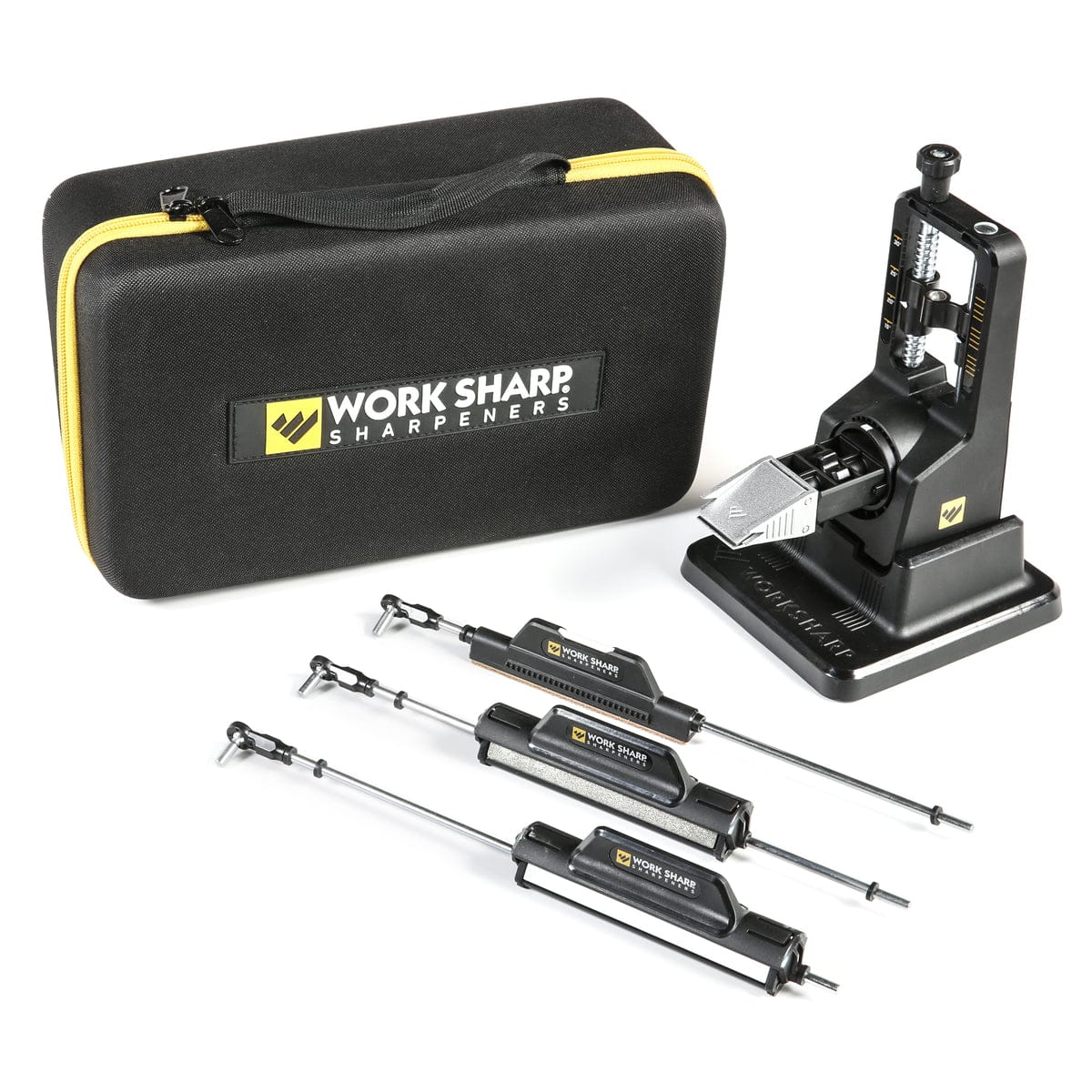
Is the Work Sharp Precision Adjust Elite worth it?
Yes, for most people who own a mix of kitchen, pocket and outdoor knives. It sets any angle from 15° to 30° in 1° steps, so you can match the maker’s edge exactly, and its diamond plates handle hard super steels. It can’t go below 15°, so thin Japanese and standard Wüsthof knives need a different sharpener, and it’s slower than a powered sharpener.
| Best for | Matching each knife’s factory angle · pocket, hunting and outdoor knives · hard super steels · owners of mixed knife collections |
| Safe for | Kitchen, pocket, hunting and outdoor knives made at 15–30° per side; serrated edges (with the ceramic rod) |
| Not for | Edges below 15°: standard Wüsthof (14°), Miyabi and other thin Japanese knives (9.5–12°) · anyone who wants a two-minute job |
| Our take | The best all-round guided sharpener for the money, as long as your knives sit at 15° or above |
Work Sharp Precision Adjust Elite specs
| Spec | Detail |
|---|---|
| Model | Precision Adjust Elite (WSBCHPAJ-ELT) |
| Angles | 15° to 30° per side, in 1° steps |
| Coarse Tri-Brasive rod | 220, 320 and 400 grit diamond |
| Fine Tri-Brasive rod | 600 and 800 grit diamond, plus a ceramic plate |
| Also included | Leather strop, ceramic rod for serrations, carry case with storage for the abrasives |
| How it works | The knife is clamped in a vise; the abrasive rod pivots on a fixed-angle arm, and you rotate the Tri-Brasive to change grit without unclamping |
| Warranty | 3 years (Work Sharp) |
| Designed in | Ashland, Oregon |
Elite or standard Precision Adjust? The standard model has the same clamp and a smaller abrasive set: a coarse diamond, a fine diamond and a ceramic hone. That’s enough for keeping knives sharp. The Elite adds more grits, including coarser diamond for reshaping and repairing edges, a leather strop and a carry case. If your knives are in good shape, the standard model is enough. If you want to reshape bevels or work on hard steels, get the Elite.
How we judged the Precision Adjust Elite
We haven’t sharpened on a Precision Adjust Elite ourselves yet, so this is a research-based review. Here’s what it’s built on:
- Work Sharp’s own specs for the Elite and the standard Precision Adjust
- Retailer listings quoting the maker, including what’s in the box and which knives it handles
- Knife makers’ published angles, checked against its 15–30° range, to see which knives it suits without reshaping the edge
- Work Sharp’s own comparison tests against its powered sharpeners
When we’ve used it on our own knives, we’ll add our notes and photos, change the label to Hands-on tested, and tell you what changed.
How to use the Precision Adjust
The short version. Follow Work Sharp’s user guide for the full method.
- 1
Find your knife’s angle
Use the maker’s angle, or color the bevel with a marker and match it. Angle chart →
- 2
Clamp the knife
Center the blade in the vise so the edge sits level. A strip of painter’s tape where the jaws grip helps avoid marks on the blade.
- 3
Set the angle and start coarse
Dial in the angle, then use light, even strokes from heel to tip on the coarsest grit the edge needs, until you can feel a small burr along the whole edge.
- 4
Flip and repeat
Rotate the knife to work the other side, then step up through the grits without unclamping.
- 5
Finish and strop
Finish on the fine diamond or ceramic, then a few light passes on the leather strop to remove the last of the burr.
Which knives and steels the Precision Adjust suits
| Shines | Struggles | |
|---|---|---|
| Angle | Any edge from 15° to 30°, matched to the degree: Zwilling (15°), Shun (16°), hunting and outdoor knives (20–25°) | Anything below 15°: standard Wüsthof (14°), Miyabi and thin Japanese knives |
| Steel | Hard super steels (S30V, M390, MagnaCut) on the diamond plates | Nothing in particular; super steels just take longer on any manual system |
| Job | Reshaping a bevel, repairing a dull edge, then refining it, all in one setup | Speed: Work Sharp’s own test found its powered Ken Onion Elite several times faster |
| Blade | Pocket, hunting, outdoor and most kitchen knives; serrations with the ceramic rod | Very long or very tall blades can need repositioning in the clamp |
Can the Precision Adjust sharpen kitchen knives?
Yes, if they’re made at 15° or more. Retailers list it for 8- to 10-inch chef’s knives, serrated knives and fillet knives. Many Western kitchen knives (Zwilling, budget brands) sit at 15–20°, which it matches exactly. For thinner Japanese knives, look at the Edge Pro below. Check your knife’s angle →
Does it work on super steels like MagnaCut?
Yes. The diamond plates cut hard steels that slow ceramic and many whetstones down. Expect it to take longer than on softer kitchen stainless; that’s true of every manual system.
If the Precision Adjust isn’t right for you
| If you need… | Look at | Why |
|---|---|---|
| Angles below 15° for thin kitchen knives | Edge Pro Apex | Reaches about 10°, and suits long kitchen knives |
| Quick touch-ups at 15° or 20°, no clamp | Spyderco Sharpmaker | Two set angles, a few minutes per knife |
| A clamp system on a budget | Lansky Deluxe | Fixed 17° / 20° / 25° / 30° |
| Speed: kitchen knives and tools in minutes | Our electric picks | Including Work Sharp’s own powered Ken Onion Mk.2 |
Work Sharp Precision Adjust questions, answered
What angles does the Work Sharp Precision Adjust sharpen?
The Elite adjusts from 15° to 30° per side in 1° steps. It can’t go below 15°, so it doesn’t suit thin Japanese knives or standard Wüsthof knives made at 14°.
Is the Precision Adjust Elite worth the extra over the standard model?
If your knives only need regular touch-ups, the standard model is enough. The Elite adds coarser diamond for reshaping and repairing edges, extra fine grits, a leather strop and a carry case, which matters if you work on dull knives or hard steels.
Is the Precision Adjust good for beginners?
Yes. The clamp and fixed-angle arm hold the angle for you, so your only job is light, even strokes. It’s one of the easiest ways to get a consistent edge without learning freehand.
Why is my Precision Adjust scratching the blade?
Usually the abrasive is touching the blade face because the knife isn’t centered, or the clamp jaws are marking it. Re-center the blade so only the edge meets the stone, and put painter’s tape on the blade where the jaws grip.
How long does it take to sharpen a knife?
A touch-up on an edge that’s already close takes a few minutes. Reshaping a dull edge or changing the angle takes longer, especially on hard steels. It’s slower than a powered sharpener but far more precise.
What warranty does it have?
Work Sharp covers its sharpeners with a 3-year warranty.
The guided sharpener for most knife owners
If your knives sit between 15° and 30°, this is the most precise way to sharpen them without learning freehand.
Not sure of your knife’s angle? Find it on the angle chart →