Home › Guided systems › Spyderco Sharpmaker review
Review · Guided systems
Spyderco Sharpmaker Review: Angles, Specs and Who It Suits
Research-based pick We haven’t used it ourselves yet. Here’s the research behind our verdict.
The Sharpmaker is the simplest guided sharpener there is: two set angles, no clamp, a few minutes per knife. Here’s what it does well, where it slows down, and which knives and steels it suits.
Not sure if 15° or 20° is right? See the angle chart →
We earn a small commission when you buy through our links. It never changes what we recommend. How we test → · Last updated: November 2026
Is the Spyderco Sharpmaker worth it?
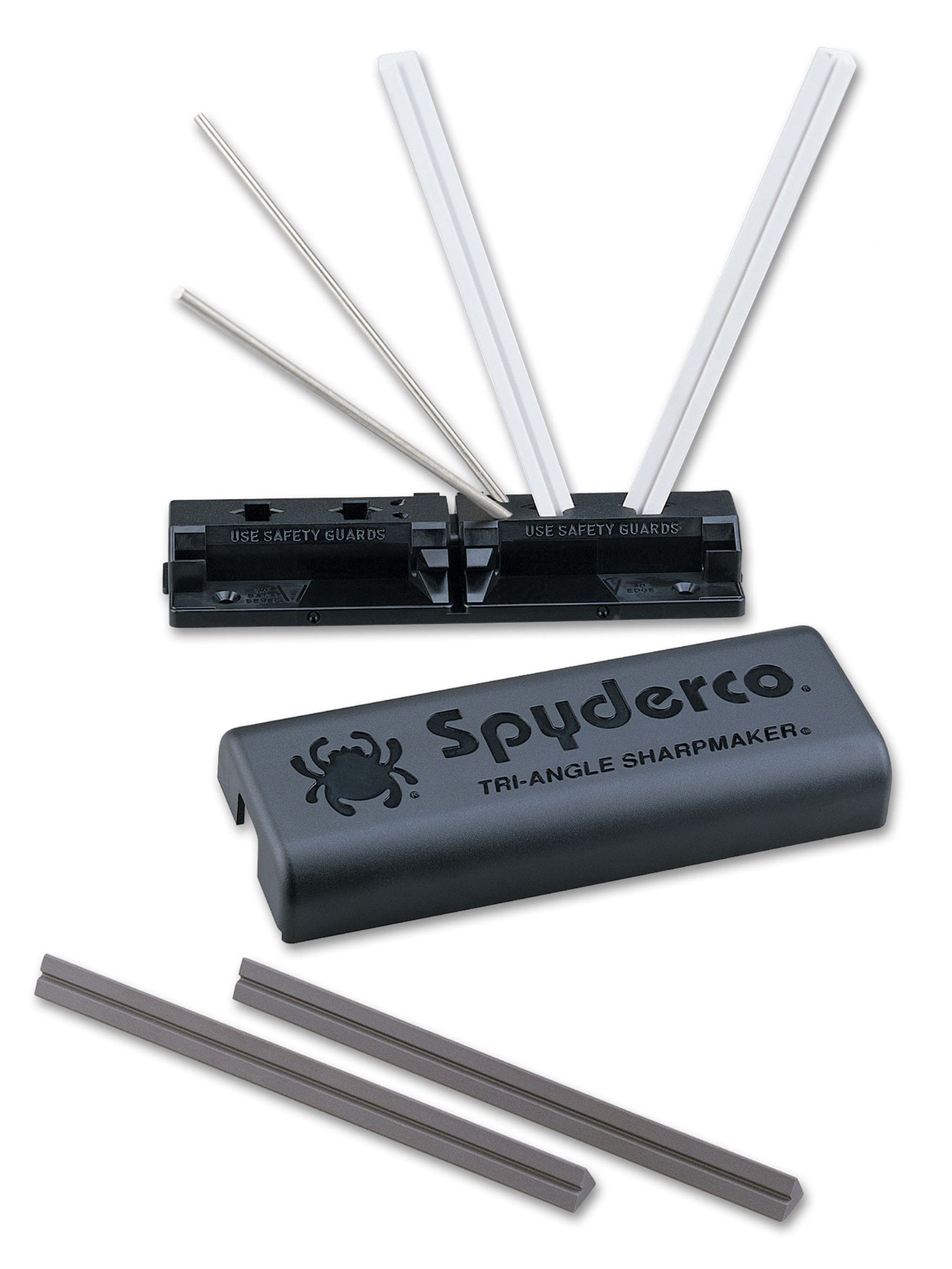
Yes, if you want a quick, hard-to-mess-up way to keep knives sharp at 15° or 20° per side. It’s built for touch-ups and serrated edges. On its stock ceramic stones it’s slow at repairing damaged edges or reshaping hard super steels, so for that, add Spyderco’s diamond or CBN stones or use a clamp system.
| Best for | Touch-ups at 15° or 20° per side · serrated knives · beginners who don’t want to hold an angle freehand |
| Safe for | Most double-bevel kitchen, pocket and outdoor knives made at 15° or 20° per side; serrations; scissors (separate setting) |
| Not for | Repairing chips or reshaping a bevel on the stock stones · knives made at other angles, like standard Wüsthof (14°), Shun (16°) or thin Japanese knives (10–12°) |
| Our take | The five-minute fix for a good knife, not a repair shop |
Spyderco Sharpmaker specs (204MF)
| Spec | Detail |
|---|---|
| Model | Tri-Angle Sharpmaker, 204MF |
| Angles | 30° or 40° inclusive = 15° or 20° per side, set by keyed holes in the base; plus a scissor setting |
| Stones included | Two medium (brown) and two fine (white) high-alumina ceramic stones, triangle-shaped |
| Serrations | Yes: use the corners of the stones |
| Hand protection | Safety rods that sit in front of the stones |
| Storage | Stones and rods snap into the base and lid |
| Lubricant | None: the ceramic stones are used dry |
| Cleaning | Scrub with a plastic scouring pad and a powdered abrasive cleanser, then air-dry |
| Instructions | Instruction book and DVD |
| Optional stones | Diamond and CBN stones (coarser, for faster steel removal) and ultra-fine ceramic (for a more polished edge), sold separately |
Degrees per side vs inclusive (the #1 Sharpmaker confusion): the base is marked 30° and 40°. Those are inclusive angles, both sides added together. So the 40° slots sharpen at 20° per side, and the 30° slots at 15° per side. More on the angle guide →
How we judged the Sharpmaker
We haven’t sharpened on a Sharpmaker ourselves yet, so this is a research-based review. Here’s what it’s built on:
- Spyderco’s own specs for the 204MF and its accessory stones
- Retailer listings that quote the maker’s instructions (used dry, how to clean the stones)
- Knife makers’ published angles, checked against the Sharpmaker’s two settings, to see which knives it suits without reshaping the edge
When we’ve used it on our own knives, we’ll add our notes and photos here, change the label to Hands-on tested, and tell you what changed.
How to use the Spyderco Sharpmaker
The short version. Follow Spyderco’s instruction book for the full method.
- 1
Pick the slot
The 40° slots (20° per side) for most knives and touch-ups; the 30° slots (15° per side) for thinner kitchen knives made at about 15°.
- 2
Start on the medium stones
Work the corners first, then the flats. Keep the blade straight up and down: the base holds the angle, so your only job is to keep the knife vertical.
- 3
Draw down and toward you
Pull the knife down the stone from heel to tip, alternating sides with light pressure.
- 4
Finish on the fine stones
Move to the white stones once the edge feels even along its length, corners then flats.
- 5
Edge not coming up? Use the marker trick
Color the bevel and take a few strokes. If the ink isn’t coming off at the very edge, your knife’s bevel is lower than the slot, and it’ll take longer to meet it. Marker trick →
Which knives and steels the Sharpmaker suits
| Shines | Struggles | |
|---|---|---|
| Angle | Knives made at 15° or 20° per side | Anything in between or below: Wüsthof standard blades (14°), Shun (16°), thin Japanese knives (10–12°). It will reshape them to 15° or 20°, which takes more steel off the first time |
| Job | Touch-ups and regular maintenance | Repairing chips or a badly rolled edge on the stock ceramic stones (slow) |
| Steel | Softer stainless and most kitchen steels | Hard super steels (S30V, M390, MagnaCut, S90V) on ceramic alone. Spyderco sells diamond and CBN stones for faster steel removal |
| Blade | Serrated knives (on the corners), pocket knives, scissors | Jobs that need an exact angle other than 15° or 20° |
Can the Sharpmaker sharpen MagnaCut and other super steels?
Yes, but slowly on the stock ceramic stones, especially if the edge needs real work. For keeping an edge that’s already close, the fine stones can be enough. For reshaping or repair, Spyderco’s diamond or CBN stones cut much faster, or use a clamp system with diamond plates.
30 vs 40 degrees: which Sharpmaker angle should you use?
Use 40° (20° per side) for most knives and for a tougher, longer-lasting edge. Use 30° (15° per side) for thinner kitchen knives made at about 15°. Some owners sharpen at 30° and finish with a few light strokes at 40°, which adds a small, stronger micro bevel. Match your knife’s factory angle first. Find it on the angle chart →
If the Sharpmaker isn’t right for you
| If you need… | Look at | Why |
|---|---|---|
| Exact angles (14°, 16°, 17°…) | Work Sharp Precision Adjust Elite | 15–30° in 1° steps, diamond plates for hard steels |
| Angles below 15° for thin kitchen knives | Edge Pro Apex | Reaches about 10°, and suits long kitchen knives |
| A clamp system on a budget | Lansky Deluxe | Fixed 17° / 20° / 25° / 30°, with an extra-coarse hone for repair |
| Kitchen knives, fast, no skill | Our electric picks | Every pick marked safe or not for German and Japanese knives |
Spyderco Sharpmaker vs Lansky
Both hold the angle for you, in different ways. The Sharpmaker uses fixed stones in a base: no clamp, very fast for touch-ups, but only 15° or 20° per side. The Lansky clamps the knife and gives you 17°, 20°, 25° or 30°, with much coarser hones for repair. For quick maintenance, the Sharpmaker. For reshaping or repairing hunting and outdoor knives, the Lansky.
Spyderco Sharpmaker questions, answered
What angle is the Spyderco Sharpmaker?
The base holds the stones at 30° or 40° inclusive, which is 15° or 20° per side. There’s also a separate setting for scissors.
Is the Spyderco Sharpmaker good for beginners?
Yes. The base sets the angle, so you only have to keep the blade vertical and draw it down the stone. That makes it one of the easiest sharpeners to get right for touch-ups.
Can the Sharpmaker sharpen serrated knives?
Yes. Use the corners of the triangle stones to work into each serration, then the flats for any plain section of the edge.
Does the Sharpmaker need oil or water?
No. The ceramic stones are used dry. When they load up with steel and look gray, scrub them with a plastic scouring pad and a powdered abrasive cleanser, then let them air-dry.
Can the Sharpmaker fix a chipped or very dull knife?
It can, but slowly on the stock medium and fine ceramic stones. For heavy repair or reshaping, use Spyderco’s diamond or CBN stones, or a clamp system with coarse stones.
Will the Sharpmaker change my knife’s angle?
If your knife was made at 15° or 20° per side, no. If it was made at another angle, like 14° or 16°, the Sharpmaker will gradually reshape it to 15° or 20°. That’s fine for most knives, but it takes more steel off the first few times.
The five-minute fix for a good knife
If your knives sit at 15° or 20° and you want them sharp again without any setup, the Sharpmaker is the simplest way to do it.
Not sure of your knife’s angle? Find it on the angle chart →