
Home › Sharpeners › Electric Knife Sharpeners
Electric sharpeners · Matched to your knife
Best Electric Knife Sharpener for Kitchen Knives (Safe for Japanese Knives Too)
Tell us what’s in your knife block, and we’ll show you the electric sharpener that suits it. Sharp kitchen knives in about five minutes, without grinding away more steel than your good knife needs.
Not sure what angle your knives use? See the angle chart →
We earn a small commission when you buy through our links. It never changes what we recommend. How we choose → · Last updated November 2026
The best electric knife sharpener for kitchen knives is the one that matches your knife’s angle. For a mixed block of German and Japanese knives, we pick the Chef’sChoice 1520, which sharpens at both 15° and 20°. All-Japanese blocks suit the Trizor 15XV, and budget Western knives the Presto EverSharp. Picks link to Amazon.com.
Our top pick Research-based pick
Chef’sChoice 1520 AngleSelect
Best for mixed knife blocks: a separate stage for 15° and for 20° knives.
Start with your knife
What’s in your knife block?
| If your knives are… | Usually sharpened at about… | Our pick | Jump to |
|---|---|---|---|
| Budget or older German-style sets (e.g. Henckels, Cuisinart, Calphalon) | 20° per side (newer lines may be narrower: check the maker) | Chef’sChoice 1520 (or a 20° model) | ↓ 1520 |
| Modern Wüsthof or Zwilling knives | 14–15° per side | Chef’sChoice Trizor 15XV | ↓ 15XV |
| Japanese knives (e.g. Global, Shun, Miyabi) | 15–16° per side | Chef’sChoice Trizor 15XV | ↓ 15XV |
| A mix of both (the most common home block) | 15° and 20° | Chef’sChoice 1520 | ↓ 1520 |
| Budget knives you just want sharp again | Around 20° | Presto EverSharp | ↓ Presto |
| Kitchen knives plus pocket knives, scissors or garden tools | 15–30° | Work Sharp Ken Onion Mk.2 | ↓ Ken Onion |
Angles are typical factory edges. Your knife maker’s own guidance always wins. Find your knife’s angle →
The best electric knife sharpeners, matched to the knives you own
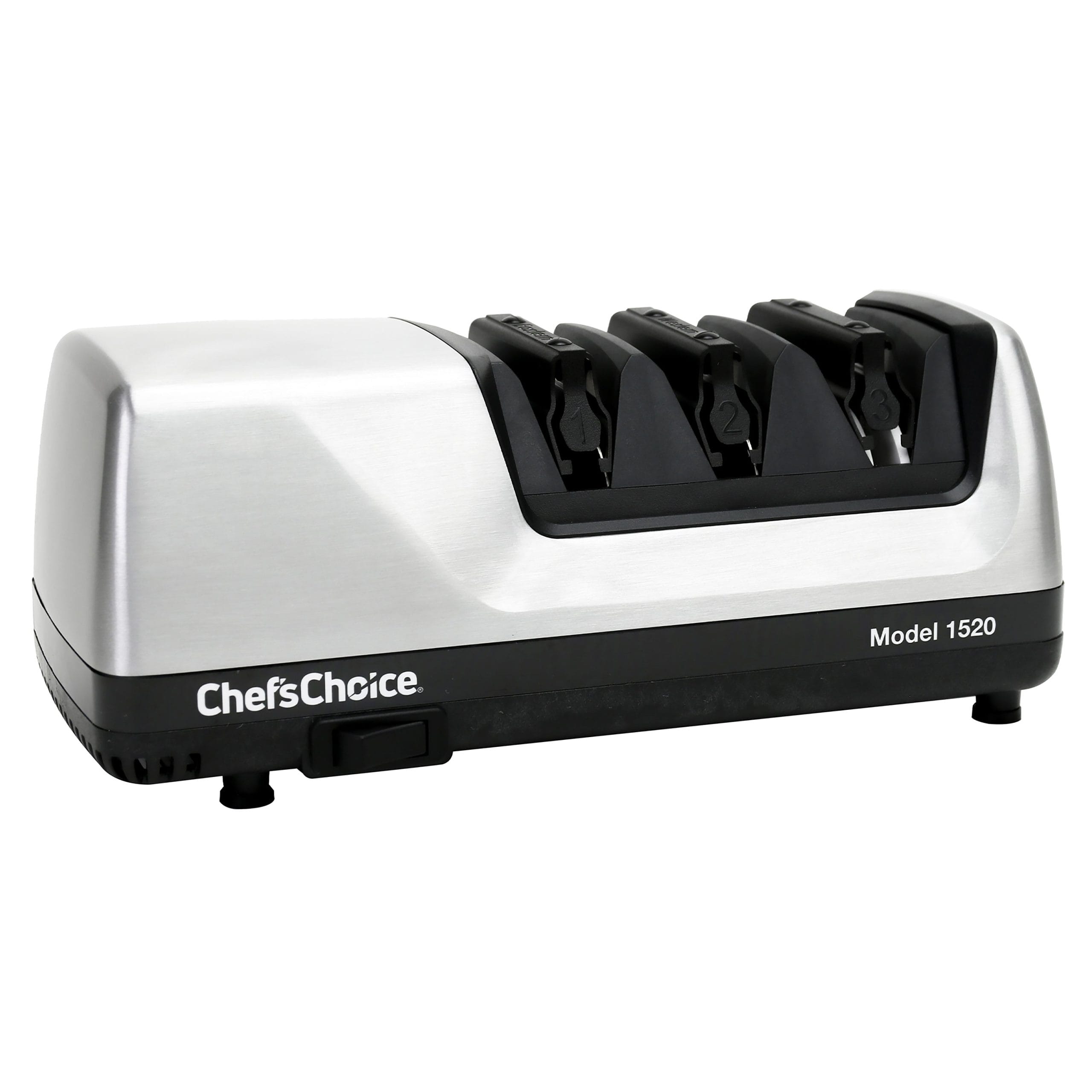
Top pick · Best for mixed knife blocksResearch-based pick15° + 20°
Chef’sChoice 1520 AngleSelect
Safe for: German-style 20° knives, Japanese-style 15° double-bevel knives, serrated knives
Not for: single-bevel Japanese knives (yanagiba, deba)
- Two angles in one machine: stage 1 sharpens 15° knives and stage 2 sharpens 20° knives, then both finish in a shared stropping stage
- Diamond abrasives with angle guides that hold the knife for you from heel to tip
- Handles straight and serrated edges, so the bread knife gets done too

Best for Japanese knivesResearch-based pick15°
Chef’sChoice Trizor 15XV EdgeSelect
Safe for: Japanese and modern 15° double-bevel kitchen knives, serrated knives
Not for: German knives you want to keep at 20°. It converts them to 15°
- A 15° edge, every time: three stages, from diamond sharpening to a polishing strop
- Converts 20° edges to 15°, which makes a German knife slice more easily but takes more steel off the first time, and changes the edge for good
- Handles straight and serrated edges, so the bread knife gets done too
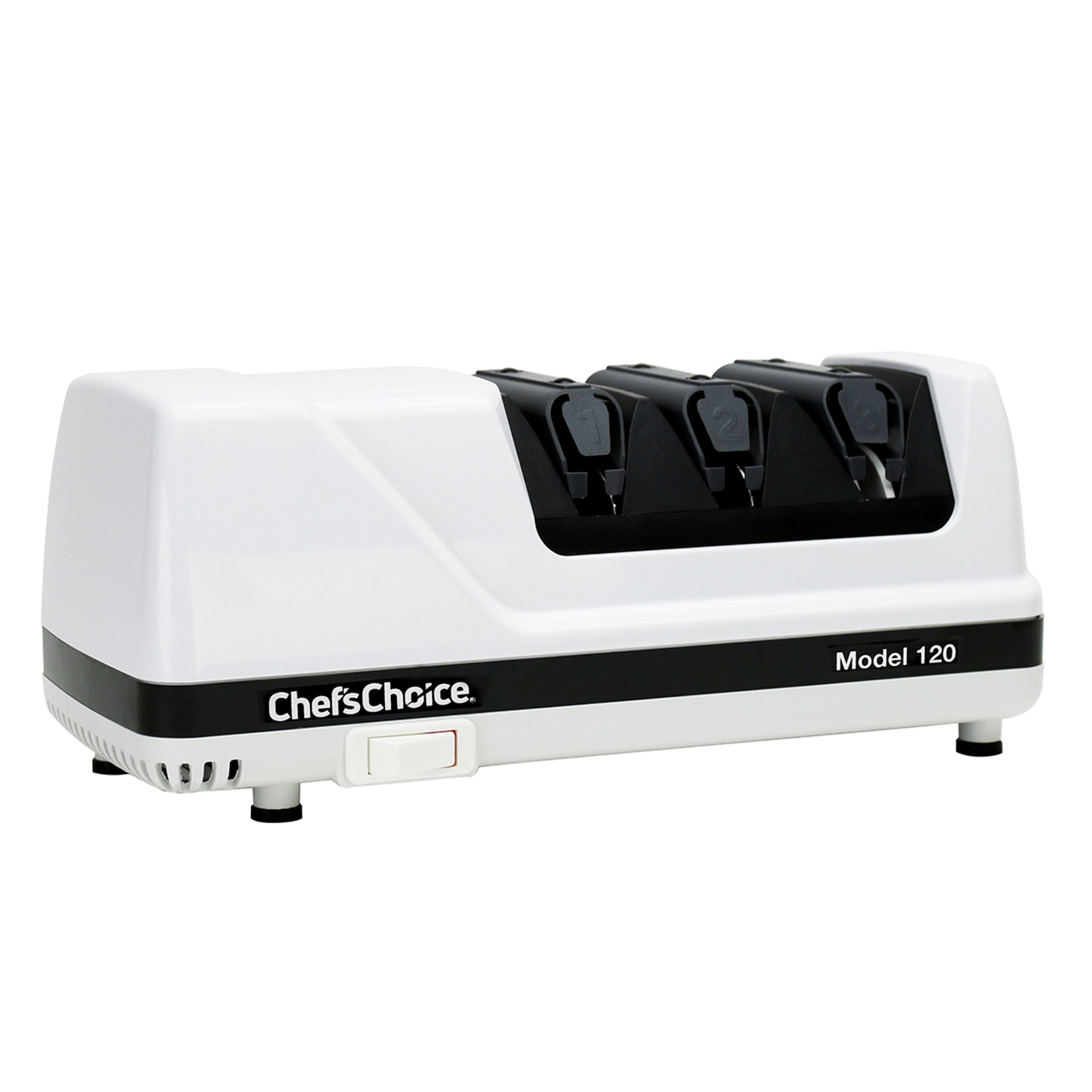
Best for an all-20° blockResearch-based pick20°
Chef’sChoice Model 120
Safe for: German-style and American 20° knives
Not for: Japanese 15–16° knives, or modern 14–15° German knives
- Built for 20° edges, the traditional angle for older German and American kitchen knives
- Three stages: coarse diamond to reshape a dull edge, medium diamond to sharpen, then stropping disks to polish
- Handles straight and serrated edges, so the bread knife gets done too

Best for simple, one-touch sharpeningResearch-based pick17°
Work Sharp Professional Electric Kitchen Knife Sharpener (E5)
Safe for: most double-bevel kitchen knives, Western and Japanese, at a 17° middle-ground angle
Not for: anyone who wants exactly 15° or 20° without buying the separate upgrade kit
- One touch: three timed programs (shape, sharpen, refine), so you can’t over-sharpen by holding it too long
- Flexible belts instead of grinding wheels, the same kind of abrasive many knife factories use
- Leather-lined 17° guides to avoid scratching the blade
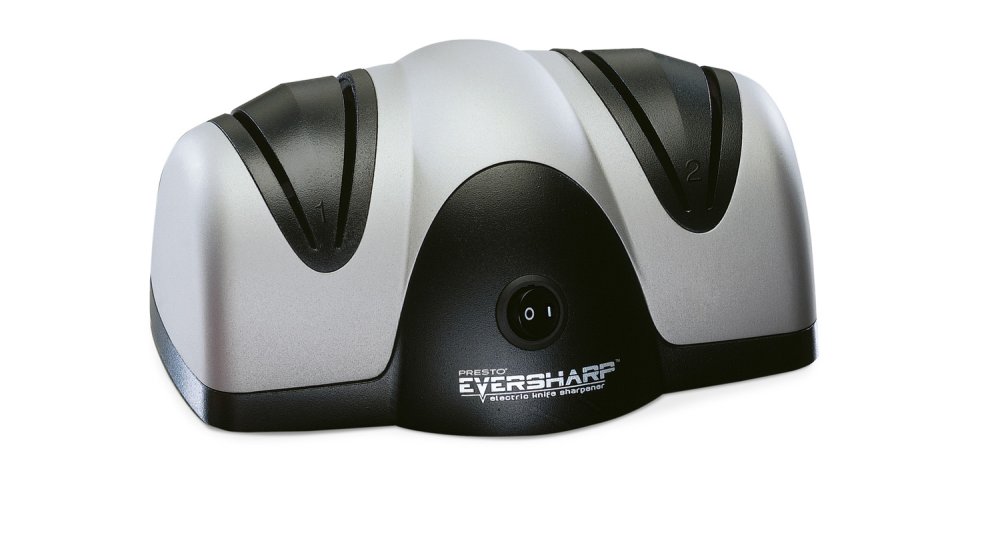
Best budget pick for everyday knivesResearch-based pick~20°
Presto EverSharp (08800)
Safe for: inexpensive Western kitchen and sport knives
Not for: Japanese knives or any knife you’d be upset to wear down
- Two stages: a coarse grind, then a fine finish
- Fixed angle: Presto doesn’t publish it, but independent reviewers measure about 20°
- Removes steel quickly, which is fine for a cheap knife and a problem for a good one
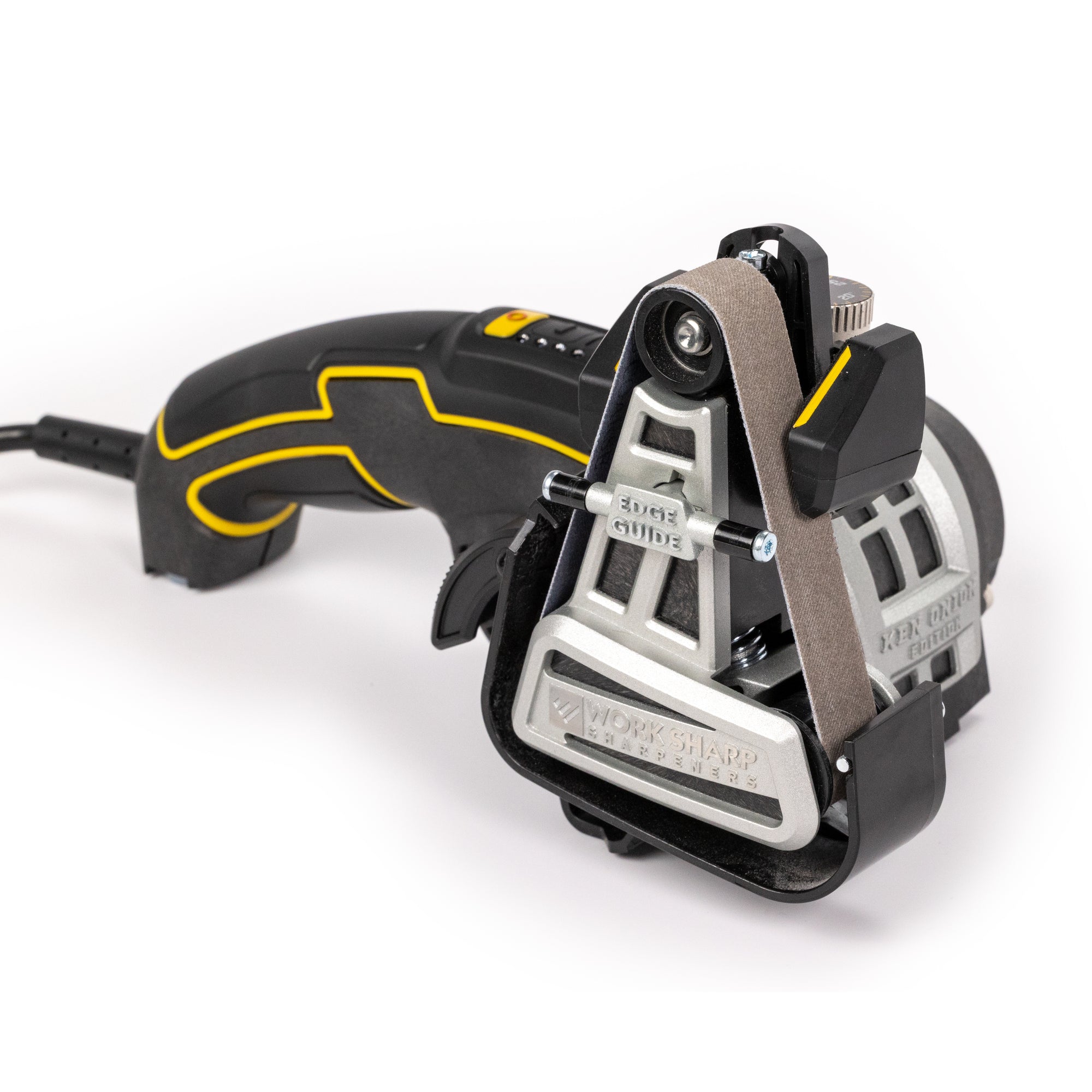
Best knife and tool sharpenerResearch-based pick15–30°
Work Sharp Ken Onion Edition Mk.2
Safe for: almost any knife (kitchen, pocket, hunting) at any angle from 15° to 30°, plus scissors and many garden and workshop tools
Not for: someone who wants set-and-forget. It takes a little practice
- Adjustable angle from 15° to 30°, in half-degree clicks, so you can match each knife exactly
- Seven speeds and interchangeable belts, from coarse repair to a fine polish
- Sharpens tools too, so one machine covers the kitchen and the garage
Electric knife sharpeners compared
| Sharpener | Best for | Angle | Japanese knives? | Serrated? | Badge |
|---|---|---|---|---|---|
| Chef’sChoice 1520 | Mixed blocks | 15° and 20° | ✔ (stage 1) | ✔ | Research-based |
| Chef’sChoice Trizor 15XV | Japanese knives | 15° | ✔ | ✔ | Research-based |
| Chef’sChoice 120 | All-20° blocks | 20° | ✘ | ✔ | Research-based |
| Work Sharp E5 | One-touch ease | 17° (15°/20° with kit) | ✔ as a compromise | ✔ | Research-based |
| Presto EverSharp | Budget knives | ~20° (fixed) | ✘ | ✔ (single-sided) | Research-based |
| Work Sharp Ken Onion Mk.2 | Knives and tools | 15–30° adjustable | ✔ | ✔ | Research-based |
How to choose an electric knife sharpener (without ruining the good knife)
Sound familiar?
The knife skids off the tomato skin and squashes it. The onion slides around the board. You know the knives need sharpening, but the last pull-through gadget left the edge feeling rough, and there’s that good Shun (or Wüsthof) someone gave you that you really don’t want to ruin.
Then every review page gives you a different “Top 12”, talks about 15° and 20° without telling you which one your knives need, and reads a lot like an ad. You want sharp knives without the risk of wrecking the good one, and you don’t want to become a sharpening expert to get there. Here’s how.
- 1
Find your knife’s angle
Check the maker’s website or the box it came in, or look it up on our angle chart. Modern German knives are often 14–15° per side, Japanese knives around 15–16°, and budget or older Western knives around 20°.
- 2
Match the sharpener to it
All 20°? A 20° sharpener. All Japanese or modern German? A 15° sharpener; avoid fixed 20° models. A mix? A sharpener with a stage for each angle. This is most kitchens. Cheap knives only? A budget sharpener is fine.
- 3
Use the coarse stage only when you need it
Use the coarse stage only when a knife is truly dull. For regular upkeep, a few pulls on the finest stage is usually enough, and it takes less steel off.
- 4
Before you buy: you might not need one
If your knife feels sharp again after a few strokes on a honing rod, it doesn’t need sharpening yet. Honing straightens an edge that’s rolled over and takes off little or no steel. Sharpen when honing stops bringing it back.
The good news: a dull knife isn’t a bad knife. With the right sharpener for its angle, it can cut like the day you bought it.
How we chose these picks (and what we haven’t done yet)
Most “best electric sharpener” pages start with a list and hope one fits. We start with the knife you own, then show you the sharpener that suits it.
We looked at what each maker says about its angles and stages, what owners report after months of use, and, most of all, which knives each one is safe for. We haven’t used these electric models ourselves yet, so each one is labeled Research-based pick. When we get hands-on, we’ll update this page and tell you what changed.
What we looked for
- The right angle for the knife: fixed 15°, fixed 20°, both, or adjustable
- Gentle on good knives
- Angle guides that hold the knife for you
- Products people will enjoy, use, and that last
Who these picks are for
Our picks link to Amazon.com, so they suit readers shopping in the US. Not covered here: single-bevel Japanese knives and ceramic knives. These need a whetstone or a specialist sharpener.
Electric knife sharpener questions, answered
Will an electric sharpener ruin my knives?
It can, if it’s the wrong one for your knife. A sharpener set at 20° takes off more steel than a 15° Japanese knife needs, and a coarse stage used too often wears any knife down faster. Match the sharpener’s angle to your knife, and use the fine stage for regular touch-ups.
Can you use an electric sharpener on Japanese knives?
Yes, if it sharpens at the right angle. Many Japanese double-bevel knives use about 15° per side, and Shun uses 16°. Choose a 15° sharpener, or one with a 15° stage, and avoid fixed 20° models. Single-bevel Japanese knives should go on a whetstone instead.
Should I choose a 15° or 20° electric sharpener?
Choose by your knives. Japanese and many modern German knives sit around 14–16° per side; budget and older Western knives around 20°. If you own both, pick a sharpener with a stage for each angle, like the Chef’sChoice 1520.
What does it mean when a sharpener “converts” a knife to 15°?
It grinds a 20° knife down to a narrower 15° edge. The knife then slices more easily, but the first session takes off more steel than usual, and the knife stays at 15° from then on.
Can electric sharpeners sharpen serrated knives?
Some can. The Chef’sChoice 1520 and Trizor 15XV are both made for straight and serrated edges, usually using only the final stage on serrations. Check the “Serrated” column in our comparison table before you buy.
Is an electric sharpener worth it, or should I pay a sharpening service?
If you cook most nights, a good electric sharpener usually pays for itself, because you can touch up your knives whenever they need it. If you only sharpen once a year, or own expensive single-bevel knives, a professional service may suit you better.
Get your knives cutting like new before the holidays
Find your knife, pick the sharpener that suits it, and be done in five minutes.
Mostly Japanese knives? Get our top pick for Japanese knives →
Ready for a sharper edge than an electric can give? A guided system holds the angle while you do the sharpening. See how guided systems work →